


Hey there! As a supplier of Inclinometer Tilt Sensors, I often get asked whether these sensors support analog output. So, I thought I'd dive into this topic and share some insights with you.
First off, let's quickly understand what inclinometer tilt sensors are. These sensors are used to measure the tilt or inclination of an object relative to the force of gravity. They're super handy in a bunch of industries, like construction, automotive, aerospace, and even consumer electronics. You can find them in everything from building structures to drones, helping to ensure safety and accuracy in various applications.
Now, onto the big question: do inclinometer tilt sensors support analog output? The short answer is yes, many of them do. Analog output is a continuous electrical signal that varies in proportion to the measured tilt angle. It's a traditional and widely used method of transmitting sensor data because it's simple and straightforward.
One of the main advantages of analog output is its compatibility with older systems. A lot of existing equipment and control systems are designed to work with analog signals. So, if you're using an older setup or integrating a new sensor into an existing system, an inclinometer with analog output can be a great choice. It allows for seamless integration without the need for complex signal conversion or additional components.
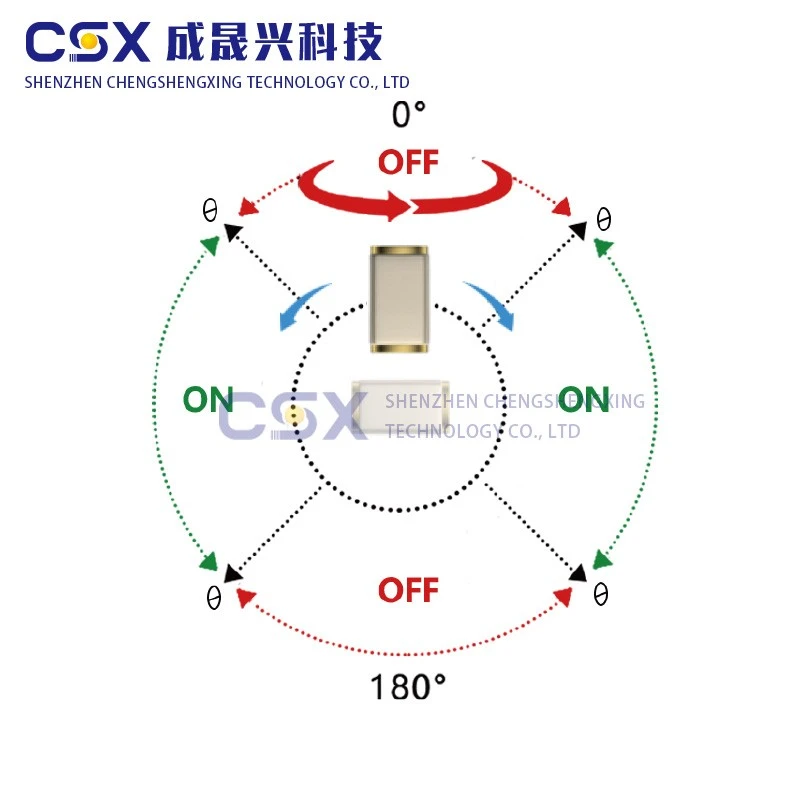

Another benefit is the real - time nature of analog signals. Since the output changes continuously with the tilt angle, you can get instant feedback on the object's inclination. This is crucial in applications where quick response times are needed, like in dynamic machinery or vehicles.
But it's not all roses. Analog signals can be more susceptible to noise and interference compared to digital signals. Electrical noise from nearby equipment, power lines, or even the environment can distort the analog output, leading to inaccurate measurements. And as the signal travels over long distances, the signal strength can degrade, further affecting the accuracy.
At our company, we offer a range of inclinometer tilt sensors with analog output. For example, our Omnidirectional Tilt Angle Detection Switch CSX - SEN - 660B provides a reliable analog output. This sensor is designed for omnidirectional tilt detection, which means it can measure tilt in multiple directions. It's great for applications where you need to monitor the tilt of an object from different angles, like in a rotating platform or a multi - axis machinery.
Our High Sensitivity Collision Sensor CSX45U also supports analog output. This sensor is not only sensitive to tilt but can also detect collisions. The analog output allows you to precisely monitor the changes in tilt and impact forces in real - time, making it suitable for applications where safety and impact detection are critical, such as in robotics or industrial automation.
And then there's the Omnidirectional Tilt Disturbance Switch CSX15. This sensor provides an analog output that can be used to detect any sudden or abnormal tilt disturbances. It's ideal for security systems or applications where you need to be alerted to any unexpected movements or tilts.
In addition to the advantages I mentioned earlier, analog output sensors are often more cost - effective. They typically require less complex circuitry and components compared to digital sensors. This means lower production costs, which can be passed on to you as a customer. So, if you're on a budget but still need a reliable tilt sensor, an analog - output inclinometer can be a great option.
However, it's important to note that digital output is also becoming increasingly popular. Digital sensors offer better accuracy, higher resolution, and more immunity to noise. They can also transmit data over longer distances without significant degradation. But that doesn't mean analog output is obsolete. In fact, many applications still prefer the simplicity and compatibility of analog signals.
When choosing an inclinometer tilt sensor with analog output, there are a few things to consider. First, you need to look at the range of the sensor. Different applications require different tilt ranges. For example, a sensor used in a small consumer device might only need to measure tilts within a few degrees, while a sensor for a large construction equipment might need to measure tilts up to 90 degrees or more.
The accuracy of the sensor is also crucial. You want a sensor that can provide precise measurements, especially in applications where safety or precision is paramount. Make sure to check the datasheet for the sensor's accuracy specifications.
Response time is another important factor. If your application requires quick detection of tilt changes, you'll need a sensor with a fast response time. Some sensors can respond to tilt changes in milliseconds, while others might have a slower response.
In conclusion, inclinometer tilt sensors do support analog output, and they offer a lot of benefits, especially in terms of compatibility, real - time feedback, and cost - effectiveness. Whether you're looking for a sensor for an existing system or a new project, our range of analog - output inclinometer tilt sensors can meet your needs.
If you're interested in learning more about our inclinometer tilt sensors or have specific requirements for your project, don't hesitate to reach out to us. We're here to help you find the perfect sensor solution. Whether you need a sensor for a small - scale consumer product or a large - scale industrial application, we've got you covered. Let's start a conversation and see how we can work together to solve your tilt - sensing challenges.
References
- Industry standards and guidelines for inclinometer sensors
- Technical datasheets of our inclinometer tilt sensors


