If you've ever spent hours troubleshooting a problem with a faulty tilt-related product-such as a medical brace triggering a false alarm, a floor-standing space heater's tip-over protection failing after some use, or a smart home device acting erratically-it's highly likely that the contacts in the mechanical ball-bearing tilt switch have oxidized or corroded. As a tilt switch supplier, we frequently encounter this type of post-sales issue: prototypes test perfectly fine, but after mass production and shipment, dust, heat, and moisture gradually cause the metal contacts to corrode, leading to a failure of the protection function.
Many engineers' first instinct is to simply replace the switches with cheap mechanical ball-bearing switches, but the problem will keep recurring. In today's blog post, we'll help you understand photoelectric tilt switches. Their biggest advantage is that they have no metal contacts, eliminating corrosion and wear at the source. We'll skip the technical jargon and share practical insights gained from real-world projects to help you quickly determine whether this product is right for your project.
How an Optoelectronic Tilt Switch Works
Traditional ball-type tilt switches rely on a metal ball making direct contact with metal contacts to establish a circuit, which can lead to oxidation and corrosion of the contacts due to moisture and dust. In contrast, photoelectric tilt switches operate on the principle of infrared beam detection and contain an infrared emitter, a receiver, and a movable ball. When the device is placed horizontally, the ball blocks the infrared beam, and the output sends a "disconnected" signal; when tilted in any direction to reach the preset trigger angle, the ball shifts, allowing the infrared beam to pass through, and the output sends a "triggered" signal.

Important Note: This device has a quiescent current and is suitable only for devices with an external power supply; it is not suitable for battery-powered products.
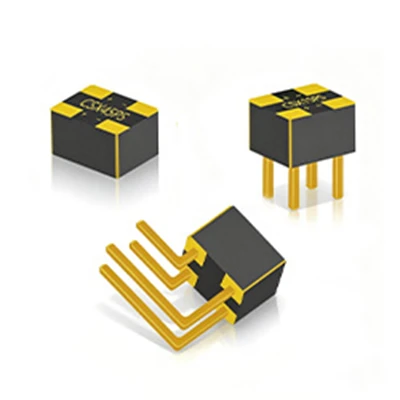
This series offers a variety of trigger angles to choose from: CSX15PS (15°), CSX30PS (30°), CSX45PS (45°), and CSX60PS (60°). The trigger angle refers to the tilt threshold at which the switch activates, and it is the key factor in selecting the appropriate model.
Key Product Highlights (Core Selling Points to Attract Readers)
1. No metal physical contacts:corrosion-resistant and wear-free: Since electrical conductivity does not rely on metal contacts, this completely eliminates the common issues of oxidation, rust, and ablation failure found in mechanical switches. With a service life of up to 50,000 hours, it is suitable for equipment requiring long-term, continuous power supply.
2. 360° omnidirectional tilt detection: Detects tilting in any direction, meeting the need for all-around tilt protection in equipment.
3. Flexible Installation and Mass Production Capability: Features a standardized package size of 4.2 × 3.2 × 3 mm and supports both SMT surface mount and DIP through-hole mounting. It can be installed on both horizontal and vertical circuit boards, making it suitable for both prototype development and high-volume automated production.
4. Stable Operation Across a Wide Temperature Range: Operating temperature range of 40℃ to +85℃, capable of withstanding temperature fluctuations caused by internal hot air currents in home appliances, medical equipment, and general industrial environments.
5. Simple Power Supply: Supports 3.3V / 5VDC, allowing direct integration with mainstream MCU control boards.
General Electrical Specifications
●Operating Voltage: 3.3V / 5VDC
●Operating Current: 10mA
●Service Life: 50,000 hours
●Operating Temperature: -40°C to +85°C
Real-world project examples to help you quickly assess how they align with your needs
Case Study 1 | Tilt Protection for Medical Care Stands-Model Selection: CSX15PS (15° Trigger)
Project Requirements: Must trigger a rapid alarm and cut off power at the slightest tilt of the equipment; the equipment remains powered year-round, so contact corrosion and failure must be prevented; powered by an external power supply. Why Choose It: Rapid triggering at a low 15° angle ensures a sensitive and safe response; the optocoupler's contactless design eliminates concerns about contact corrosion from long-term use; both SMT and DIP mounting options accommodate different PCB designs.
Case 2 | Tilt-Off Protection for Floor-Standing Space Heaters-Model CSX30PS (30° Trigger)
Project Requirements: Power cutoff protection when the device tilts 30°; the device contains heat and dust; operational vibrations must not cause false triggers; powered by an external AC power source. Why Choose It: 30° is the standard threshold for tip-over protection in small appliances; the sealed housing isolates internal heat and dust; the contactless design eliminates the aging and failure issues associated with traditional ball-switch mechanisms.
Self-Assessment Checklist: Helps You Quickly Determine Whether This Product Is Worth Purchasing
After reading the questions below, you'll be able to determine whether this project is right for you:
✅ This product is suitable for purchase if your project meets the following conditions:
1. The device is powered by an external power source and can handle a 10 mA quiescent operating current;
2. The product requires long-term, continuous power supply and cannot tolerate subsequent failures caused by contact corrosion or poor contact;
3. 360° omnidirectional tilt detection is required;
4. The application environment contains dust and hot air, which can cause mechanical ball switches to fail;
5. Both prototyping and debugging are required, while also accommodating high-volume SMT production.
❌ We do not recommend this product if your project meets any of the following conditions:
1. Battery-powered devices with strict requirements for quiescent power consumption;
2. Consumer products designed for extremely low cost, simple indoor use, and short service life (a standard mechanical ball-switch is sufficient);
3. Devices with a supply voltage other than 3.3V or 5V, where voltage conversion is not possible.1.
Tips for Avoiding Pitfalls When Selecting a Model
Do not ignore static current, as it can quickly drain the battery's charge;
2. Select the correct trigger angle based on your safety protection logic; do not choose a 60° model for applications requiring a small trigger angle;
3. Never supply power exceeding 3.3V or 5V, as this will immediately burn out the device.
If you've analyzed your project requirements but are still unsure about the optimal angle or solution, there's no need to resort to trial and error. Whether you're an R&D engineer in the home appliance, medical, or industrial equipment sectors, or a high-volume OEM purchaser, feel free to contact us. We can provide sample testing, deliver performance test reports, and help you determine the appropriate trigger angle.
Ultimately, the core value of the photoelectric tilt switch lies in its contactless design, which addresses the pain points of corrosion and wear associated with mechanical switches. If you're struggling with contact failure in ball-switches, this product is worth evaluating. If you need to review the product specifications in detail, the link to the datasheet is provided below; if you require one-on-one technical support for product selection, please feel free to contact our team.
References: International Electrotechnical Commission (IEC) 60947-5-3: Technical and Application Guidelines for Tilt Switches, 2021; Industrial Electronics Association (IEA) Reliability Test Report on Photoelectric Tilt Sensors, 2022; *Journal of Sensors and Actuators*: Application of Contactless Photoelectric Tilt Switches in Safety Solutions for Home Appliances and Medical Devices, Vol. 18, No. 2, 2023
#PhotoelectricTiltSwitch #CSX-PS #TiltSensor #HomeApplianceSafety #MedicalSensor