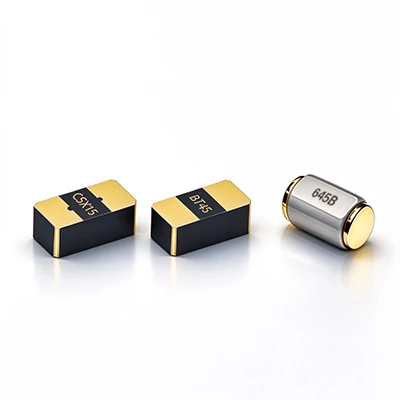
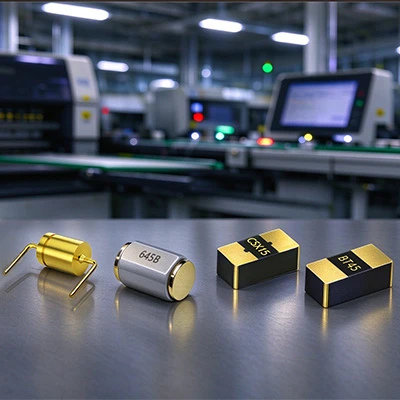
When designing motion detection and vibration-based wake-up systems, engineers often face two practical challenges: different products require different trigger sensitivities, which typically necessitates stocking multiple components; and different electrical platforms operate at different voltages, adding to the costs of level matching and component selection. The CSX series of purely mechanical ball-type vibration switches offers a more flexible solution: with a wide operating voltage range of 0.5–24 VDC and MCU-software-adjustable sensitivity, a single device type can cover a wide range of applications without the need for frequent hardware modifications.
Purely mechanical gold-plated ball bearings that directly output voltage level changes
For applications that only require a determination of "whether vibration has occurred" rather than full acceleration data acquisition, this purely mechanical output method can significantly simplify software and peripheral circuit design.

| Model | Dimensions |
| CSX-SEN-180A | 2×2×3 mm |
| CSX-SEN-200A | 2.5×2.5×4.8 mm |
| CSX-SEN-300A | 3×3×5.2 mm |
| Item | Specifications |
| Standby Power Consumption | ≈0 μA |
| Operating Voltage | 0.5–24 VDC |
| Contact Resistance | <30 Ω |
| Insulation Resistance | >10 MΩ |
| Operating Temperature | -40°C to +85°C |
| Package Type | SMT Surface Mount |
| Available Sizes | 2×2×3 mm / 2.5×2.5×4.8 mm / 3×3×5.2 mm |
Low contact resistance and high insulation resistance help ensure stable signal connections; the operating temperature range of -40°C to +85°C covers most consumer electronics, outdoor equipment, and general industrial applications.
What applications is it suitable for?
CSX vibration switches are ideal for low-power, compact designs centered on "vibration/displacement triggering":
Bicycle speedometers: Automatically wake up when riding begins, reducing continuous polling.
Red-dot sights and gun sights: Triggered when powered on or picked up.
Smart home vibration alarms: Detect abnormal vibrations in doors, windows, devices, or objects.
Low-power logistics asset tracking tags: Wake up and report when vibrations or displacement occur during transport.
ESP32 and maker projects: Used for vibration wake-up, tilt detection, and low-power sensor nodes.
Design Note: The system current is determined by the external voltage-dividing resistor.
The actual circuit current is determined by the external voltage-dividing resistors, not by the vibration switch itself. When designing pull-up and pull-down resistors, selecting the appropriate resistance values is critical for achieving a microampere-level sleep mode. In other words, while the vibration switch provides a mechanical triggering mechanism, system-level power consumption still requires optimization through the peripheral circuitry.
Relationship to MEMS Solutions: Not a Replacement for Everything, but a Simplification for Specific Needs
MEMS accelerometers are suitable for applications requiring complete acceleration data, attitude estimation, or high-frequency sampling. However, if a project only requires vibration wake-up, tilt detection, or simple motion triggering, purely mechanical ball-type vibration switches like the CSX can eliminate the need for complex register configuration and continuous data acquisition, allowing the MCU to remain in deep sleep mode for extended periods and wake up only when a signal change occurs. For cost-sensitive, battery-powered motion-detection devices with long standby times, this is a simplified solution worth evaluating.
Conclusion
The CSX series of ball-type vibration switches offers more than just "low power consumption"; their true value lies in design flexibility: a wide voltage range of 0.5–24 VDC, MCU-software-adjustable sensitivity, three SMT sizes, and a purely mechanical gold-plated ball structure enable a single device family to meet a wide range of motion detection needs, including wearables, smart home devices, red dot sights, logistics tracking, and DIY projects. For developers seeking a vibration-triggered solution that requires "minimal hardware modifications and rapid adaptation to multiple scenarios," this is a selection path worth considering.
If you are evaluating vibration switches in terms of voltage compatibility, package size, or sensitivity adjustment methods, please feel free to contact us to discuss your specific requirements; we can match you with the appropriate model based on your application scenario.
References: Manufacturer's Technical Data Sheet: "Performance of Vibration Switches Under Different Humidity Conditions," 2023; Industrial Electronics Association: "Environmental Impact Testing of Vibration Sensors," 2022; *Journal of Sensors and Actuators*: "The Effect of Condensation on the Reliability of Mechanical Vibration Switches," Vol. 15, No. 2, 2021.