small appliances, outdoor sensors, security alarms, and automotive accessory projects, ball-tilt switches perform safety detection functions such as tip-over power cutoff, tilt detection, and vibration wake-up. When selecting products, many engineers focus solely on price and overlook differences in contact plating processes. As a result, issues such as poor contact, poor temperature range adaptability, and failure in humid environments often arise after mass production begins. The plating process is precisely what sets the reliability of ball switches apart.
Most budget-priced ball switches on the market use silver-plated contacts and standard steel balls. Silver plating is low-cost, but its shortcomings are very evident: silver is prone to sulfidation and oxidation. In environments with high humidity, salt fog, or significant temperature fluctuations, an insulating sulfide layer gradually forms on the contact surface, causing contact resistance to rise continuously and leading to intermittent failures such as "sometimes conducting, sometimes unresponsive." Stability deteriorates further under low-temperature conditions, and the long-term service life is limited, making them suitable only for dry indoor environments and low-demand consumer products.

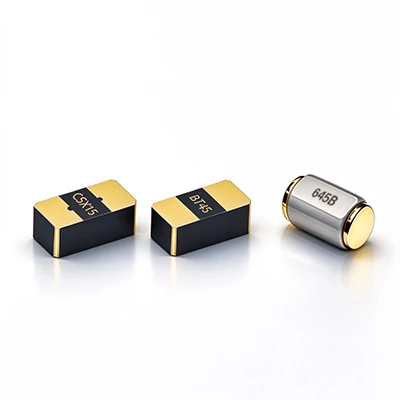
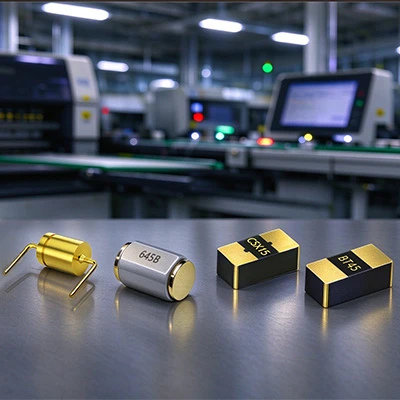
Our BT45 series of fully gold-plated ball-tilt switches-with gold-plated balls, internal contacts, and chamber walls-offer several key advantages:
1. Resistance to oxidation and sulfidation, with long-term stable contact resistance: Gold is chemically stable and does not easily oxidize or turn black. It maintains a stable, low resistance even in humid environments or under temperature fluctuations, making it suitable for applications with significant temperature variations-such as outdoor, cold chain, and automotive settings-with a rated temperature range of -40°C to 85°C;
2. Excellent conduction consistency, suitable for microcurrent signals: Many IoT and battery-powered devices operate at extremely low currents; standard silver-plated switches often fail to conduct microcurrents, whereas gold-plated contacts can reliably capture even the faintest signals;
3. Longer service life: Capable of withstanding millions of tilt-triggering cycles, with a failure rate far lower than that of standard silver-plated models in high-frequency operation scenarios.
Of course, not all projects require fully gold-plated switches. For simple indoor toys or short-term, single-use products, standard silver-plated switches are sufficient; however, for products that require long-term, stable operation, must pass reliability testing, or are deployed outdoors or in humid environments, fully gold-plated ball-switches-both internally and externally-are the safest choice.
Simple Selection Guide:
●Standard silver-plated ball switches: Dry indoor environments, low-cost toys-prioritize budget;
●Fully gold-plated ball switches (both inner and outer): Outdoor sensors, tip-over protection for space heaters, cold chain monitoring, automotive components, security alarms-prioritize long-term reliability.
If you're unsure which ball-tilt switch to use for your project, please send us the operating conditions, temperature, and current requirements, and we'll recommend a suitable model and provide samples for testing.